One of the most compelling mysteries of the McQuivey family is “Where do we come from?” While the evidence available up until this point provides us more questions than answers, our best guess is that our ancestor, James MacWithey (aka McRorie), was a prisoner of war, who’d been captured at the Battle of Dunbar and sold as an indentured servant to the American Colonies in 1651.
For some, that answer is enough. For others of us, it’s the spark that lights the insatiable fire of curiosity.
If you are of the latter persuasion, buckle up and hear this crazy theory.
What we know about the McQuivey line:
Our earliest documented McQuivey ancestor is Nathaniel McQuivey (1775-1843), who shows up in the 1840 US Census and whose gravestone bears the same name. He also shows up in other documents under a variety of surnames such as McQuavy, McWithey, and McWorthy, but the reasoning for using the form “McQuivey” is given in the American Genealogist Magazine Vol 26 pg 195. The magazine states:
It appears that most, if not all, of those who bear the name McQuivey or Quivey descend from Nathan. In Adams’ A History of the Town of Fair Haven, Vermont, 1870, p. 25, we find an explanation of the change in spelling of the name; it says, ‘….McWithey, called by the old people ‘McQuivey’.
So it sounds like Nathan started pronouncing or spelling the name a bit differently, perhaps in order to be more in keeping with the way “the old people” were doing things. But just who are these “old people” and where the heck are they getting “McQuivey” from? Because if you jump over to Scottish records and start searching for McQuiveys, you’re going to come up dryer than a PB&J left out in the Sahara Desert.
Well let’s take another couple of family history steps back to our earliest confirmed ancestor—James MacWithey/McRorie/Mackerwithee. He shows up in Massachusetts state records in the 1660s. We have marriage records for him, he’s listed in his children’s birth documents, and his father-in-law mentions him in his will. But none of those documents make mention of where or when he was born or even where he’s buried.
This is where things get interesting. The particular place in Massachusetts that James shows up in is a hotspot for Scottish immigrants—particularly former indentured servants. Some people much smarter than me have connected him to an even narrower community of Scottish men who were prisoners of war captured in either the Battle of Dunbar or Battle of Worcester during the English Civil Wars.
Here is a lovely summary of what we know, as presented by the Scottish Prisoners of War Society (SPOWS).
As you scroll through the information on that page, you will eventually come to a little footnote dated 7 Feb 2019. Someone found an old family letter from 1839 and submitted the information to SPOWS. From that letter, we get these intriguing details:
My father’s mother was descended from a Scottish Highlander of the name of ‘Maceraithy’ who fought against Cromwell at the battles of Dunbar and Worcester in the sixteenth (sic) century
So the theory that James was a prisoner of war from the English Civil Wars goes back at least to the 1800s. This letter writer says James fought in both Dunbar and Worcester, however SPOWS only lists him as possible for Dunbar and doesn’t mention anything about Worcester. Let us note two important things:
First, this letter was written almost two hundred years after James arrived in the colonies. It’s gone through a few generations of “telephone,” and details very well could have gotten smudged. (We already have an example of smudged details as the writer inaccurately dated the battles to the sixteenth century).
Second, we don’t have much surviving documentation of the Dunbar prisoners. Thanks to letters Cromwell and his officers were sending back and forth, we can follow their trail as they marched from Dunbar to England. We also know that a good chunk of them were sent to the colonies aboard the Unity. But the Unity’s passenger list has never been found.
We do, however, have a passenger list for the John and Sarah, which brought over prisoners from the Battle of Worcester. So the reasoning is that if we suspect someone was a Scottish prisoner and they don’t show up on the John and Sarah, then they’re probably from Dunbar. But there’s still room for doubt and debate between the two groups, so we can’t discount anything yet. He could have fought in both. Or maybe neither. Unfortunately, we’re doing a historical jigsaw puzzle that’s missing more pieces than not. At least the Dunbar theory gives us a few pieces to work with.
One last little tidbit I’ll mention here is that there’s this theory floating around that the McQuiveys had connections to the MacDonald clan. From what I can tell, this is mostly speculation or an orally passed-on family theory… but put it in your pocket because we’ll come back to it.
History Lessons
If I haven’t put you to sleep yet, get your Diet Coke, Dr. Pepper, coffee, or whatever form of wake-up juice you prefer because we’re going to do a really fun deep dive that you don’t want to miss.
That previous section has probably led you to realize the problem we face here. Coming at this from the McQuivey side of things doesn’t get us very far. We deadend at every turn because there simply isn’t documentation. The name McQuivey doesn’t exist across the pond. So in order to figure out where we fit into all of this, we have to step back and look at the bigger picture. This requires (heavy sigh) studying history.
I’ll spare you the extent of my own studies and just summarize what I’ve been doing with this obsession the last few years.
My initial thought was “Well hey, if he was a highlander in the 17th century, he probably spoke Gaelic, right? What if the whole ‘McQuivey, as the old folks say’ is the family’s attempt to make the Anglicized name sound more Scottish?” So I started studying Gaelic, at least enough to be able to figure out how to pronounce Gaelic names, hoping I’d stumble across something that could potentially be Anglicized into both McQuivey and Mackerwithey.
I came up with a couple of options, which led me to the next historical hurdle.
Had any of these clans been involved in Dunbar and Worcester?
This required the heaviest studying of all. I needed to understand what caused the English Civil Wars, why different groups got involved, and who was likely to have been in the right place at the right time.
This is where we get to my theory.
The Battle of Dunbar itself is quite well documented, and we even know several regiments that are confirmed to have fought in the battle because the English were extremely happy to brag about just whose colors and which officers they’d captured. I researched a bunch of these, trying to fit the tidbits we know about James into the bigger context of these regiments and their activity during the Civil Wars. There were lots of dubious possibilities, but nothing really clicked into place until I got researching a guy who did some cool things at Dunbar. His name is Sir James Campbell of Lawers.
Here’s some cool history about his regiment if you’d like: Clicky Clicky, but if you don’t want to delve in that deep, no worries. I’ll summarize the important bits here.
In short, the Campbells were in charge of mustering troops from an area of Scotland known as Argyll. Here’s a map of the recruiting grounds that I found in a fantastic book called A Regimental History of the Covenanting Armies 1639-1651 by Edward M Furgol. (This is one of the main sources SPOWS uses for their own research into the Dunbar and Worcester prisoners). If you want some “light reading” you can read it for free here.
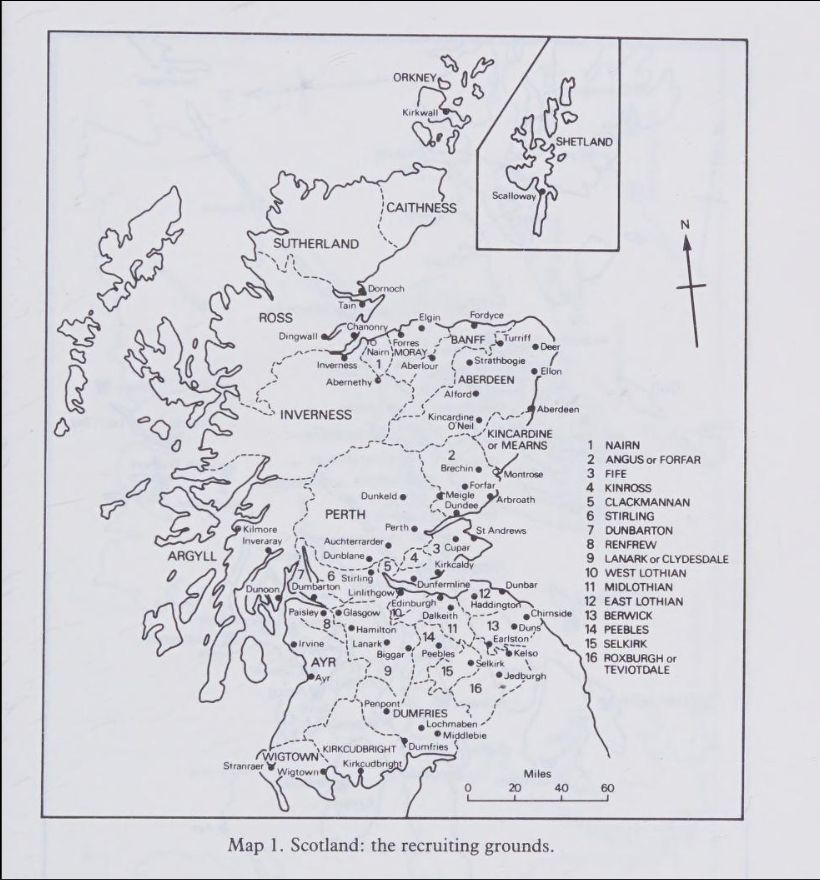
You’ll find Argyll in the middle left. It covers a big chunk of Western Scotland and the Inner Hebrides. Now I’ll draw your attention to this little map of clan territories I found on Wikipedia. Let’s focus on the area of Argyll as shown in the recruiting grounds map…
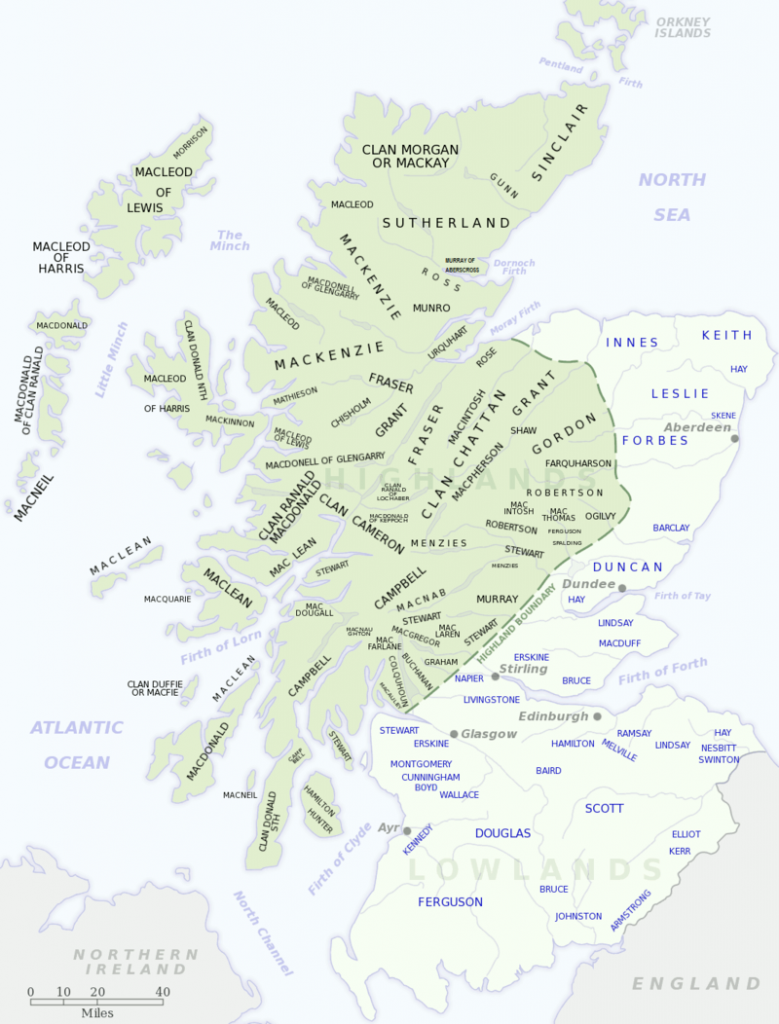
Take a look at the southwest islands. You’ll see a big one marked with MACDONALD. Cool, let’s focus there since we have this family theory that we’re connected somehow. Around them, we have Macleans, Macneils, MacQuaries (don’t get too excited—I already checked them out and that’s a deadend). How about Clan Duffie or MacFie? You know, if you imagine saying MacFie with a really strong Gaelic brogue-ish accent… Makh-i-fee…. And then you try to say McQuivey with that same really strong Gaelic brogue-ish accent… Makh-wi-vee. Say it out loud, and hot dang, they’re almost indistinguishable.
Hold on though. It’s not like I’m a native speaker or even anywhere close to being an expert on these things. But it’s promising enough to warrant some further research.
More studying! … Hurray?
Lucky for you guys, you have someone to feed you just the highlights.
First, let’s take a look at MacFie in its Gaelic form.
The earliest form is Mac Dhuibhshíthe. Let’s break that down a little. Here’s a great website that I lean on heavily for all things Gaelic.
“Mac” means “son.” It’s pronounced “makh”
“Dhuibh,” is a grammatical form of “dubh” and means “of the dark.” It’s pronounced something like “gyoov”
“Shíthe” is a grammatical form of “síth” and can mean either “peaceful” or “of the fairies.” It’s pronounced “hee-heh”
So put these together, and you get something like “Makh Gyoov-hee-heh.” Say that out loud a few times.
Another couple fun tidbits with Gaelic.
First, this “kh” I’ve been putting on “Mac” is because it’s guttural. Phlegmy. It’s not “mack,” it’s “makkkh” like you’re clearing your throat. Put that right up against the “gyoo” sound in ‘dhuibh’ and you have an awkward little transition that our English speaking brains have a hard time making sense of. How many syllables even is that?? Mak-ga-yoov? Mag-ka-what now??
Second, when you listen to Gaelic speakers, you’ll notice quickly that there is often an extra syllable–a little ‘i’ sound–tossed between consonants.
So if a Gaelic voice says “Mac Dhuibhshíthe” at an English brain, that poor English brain might register it as something like “Mak-ga-yoov-i-hee.” Or if the Gaelic speaker is using the newer version of the name, Mac Dhubhsíth, that English brain might hear “Makh-gyoov-i-shee-eh.” Or if the Gaelic speaker came from a place that had grown tired of all the syllables and was now using the truncated version, Mac A’ Phi, that English brain might hear “Makh-a-fee.”
Early McQuivey ancestors used all sorts of odd, seemingly unrelated spellings like Mackerwishee, Macwithee, and McQuivey. If you squint with your ears at all these different variations of Mac Dhuibhshìthe, it starts to make some sense, especially considering the fact that they didn’t have standardized spelling in English or Gaelic yet, so there were likely as many different ways to spell and pronounce a name as people who claimed the name. siiiiiigh
Setting aside pronunciation for a moment, on the MacFie Clan Society of America website, we find some examples of variations of MacFie that crop up in various regions. Check this one out.
In Kintyre the name assumed the form M’Covvie (Mac-ko-vee) some of this name emigrated to Canada before the middle of the 19th century.
Pardon?? M’Covvie?? Now if that’s not the darn nearest thing to McQuivey I’ve come across in all these shenanigans.
So if your brain works like mine, things are looking encouraging… but none of this is truly proof that the McQuiveys were once MacFies. And maybe your brain doesn’t work like mine and you’ve been raising a skeptical brow at me for the last page and half anyway. Any way we look at it, this is just Sara trying to shove McQuivey into a neat, tidy Gaelic box when nothing about any of this is neat and tidy.
(Shopping channel voice) But WAIT! There’s MORE!
Remember that thing you put in your pocket a while ago? The family theory that the McQuiveys were affiliated with the MacDonald clan? Go ahead and pull that out now.
In 1615, the MacDonalds came up with this scheme to rebel against the government and convinced their on-again-off-again allies/rivals the MacFies to join in. Long story short, bad things happened, ending with the MacFie chief and his sons losing their heads. Literally. There were some rocky years afterward, but by 1650, when our man James came on the scene, the MacFie clan and territory was under control of… you guessed it. The MACDONALDS.
So put a big check mark on the MacDonald affiliation theory. I’ve even heard some say the McQuiveys were servants to the MacDonald clan, which arguably fits this scenario, though I suspect if you’d called a 17th century MacFie a MacDonald’s servant, you’d probably go to sleep with a black eye.
Now we’re going to circle back just a bit and return to the family letter that mentioned so-and-so’s great granddad fighting in Dunbar AND Worcester, but like we discussed earlier, SPOWS only lists James under Dunbar. Remember our two points? Generational telephone and incomplete records.
Well there’s actually a third point to consider.
Let’s go back to Sir James Campbell’s regiment that we know fought at Dunbar. It turns out that Campbell’s regiment wasn’t completely obliterated at Dunbar. A good portion of them, especially his cavalry, escaped the aftermath of Dunbar and survived to fight a year later at Worcester.
So maybe our James didn’t personally fight at Worcester, but if he was part of Campbell’s regiment, he certainly could have had friends that did. Many more were then captured at Worcester and could have ended up in the same place in the colonies. And remember that the letter in question was written two hundred years after the fact. It’s entirely plausible that Granddad James told the story, “Me and my buddies fought in Dunbar and Worcester,” which was interpreted a couple generations later to “Granddad fought in Dunbar and Worcester.”
Or maybe James really did fight in both and was either listed under a different name on the John and Sarah or came over on a different ship. We really have no way of knowing for sure.
Get Yer Tartans On!
So what does this mean going forward? What do we do with this information?
Well no one is stopping you from claiming whatever clan you want as your own and going gung-ho at Highland festivals. You want to claim MacFies? Go ahead and claim MacFies. You want to just grab whatever tartan looks cool and claim that? Go ahead. Everyone I’ve ever talked to at festivals would love to claim anyone who wants to be claimed, regardless of lineage. If you’re still hesitant, here’s another little historical nugget I’ll leave you with.
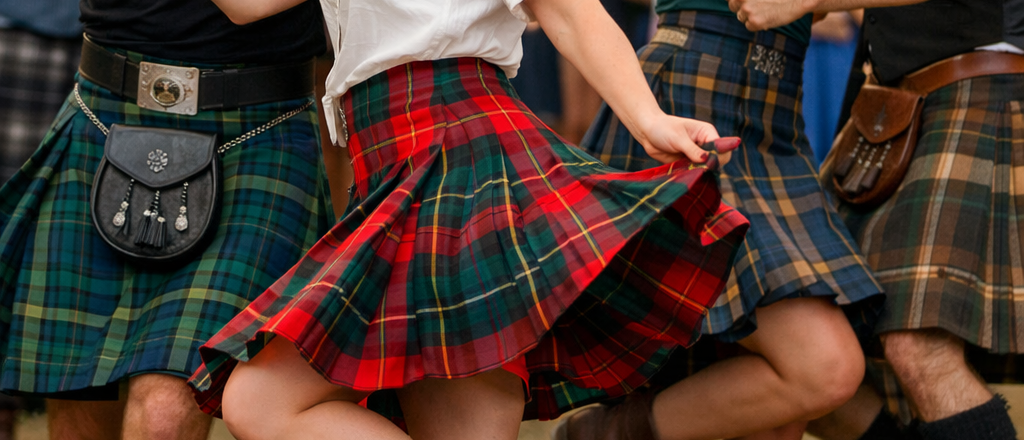
In the time period we’re talking about right now, belted plaids are just barely a for-sure documented thing. The tailored kilts and clan tartans we’re used to won’t be a thing for another century or so. So you can belt any ol’ length of wool or linen around your waist and call it the historical garb of your ancestors.
And actually, belted plaids at this time would have commonly come in solid earthy colors or what we now call “shepherds plaid” (basically just a checkered pattern). “Plaid” plaid (what is actually known as “tartan”–that distinctive overlapping stripes and boxes pattern) was certainly available as well, but it actually came about because you could only dye material in small batches, so it was very difficult to match colors perfectly. Tartan has been developed in almost every weaving culture (not just Scotland) because it’s a clever way to arrange mismatched colors to make it look on purpose. It would have been extremely difficult and costly to produce identical lengths of tartan for any two people, let alone a whole family or village. Clan-specific tartans weren’t a thing until the Highland Revival in the 1800s and was only possible because they could weave consistent batches of tartan in factories.
Here’s a great source on the history of the kilt and a video on historic Scottish fashion in general if that wasn’t a nerdy enough side trip for you.
“But, Sara! I crave validation!”
Siiiiiigh. Me too, me too. I would love nothing more than to see McQuivey on some list of accepted clan variations. 🥹 If that’s the goal, the next step would be to contact whoever is considered “in charge” of the MacFie clan, but that’s a bit of a hiccup. Some clans still have recognized chiefs, but ours got beheaded in 1615 and we kind of split off and assimilated into a bunch of other clans afterwards. From what I can tell, the Court of the Lord of Lyon are the peeps that give approval for everything Scottish Clan related, so we could try contacting them. But even if we contact someone and say, “Hey! I think we’re MacFies! Listen to my theory! Will you claim us please?” they might not think our flimsy evidence is enough to declare McQuivey an accepted variation of the clan name…
… But it might be worth a try?
Oh and if anyone is planning a trip to Scotland for any more family history excursions… Please please PLEEEEEASE include the isle of Colonsay—the ancestral home of the MacFie clan—on your site-seeing list. If there is further information about James and his ancestry anywhere, there’s a chance it’s on that island.